
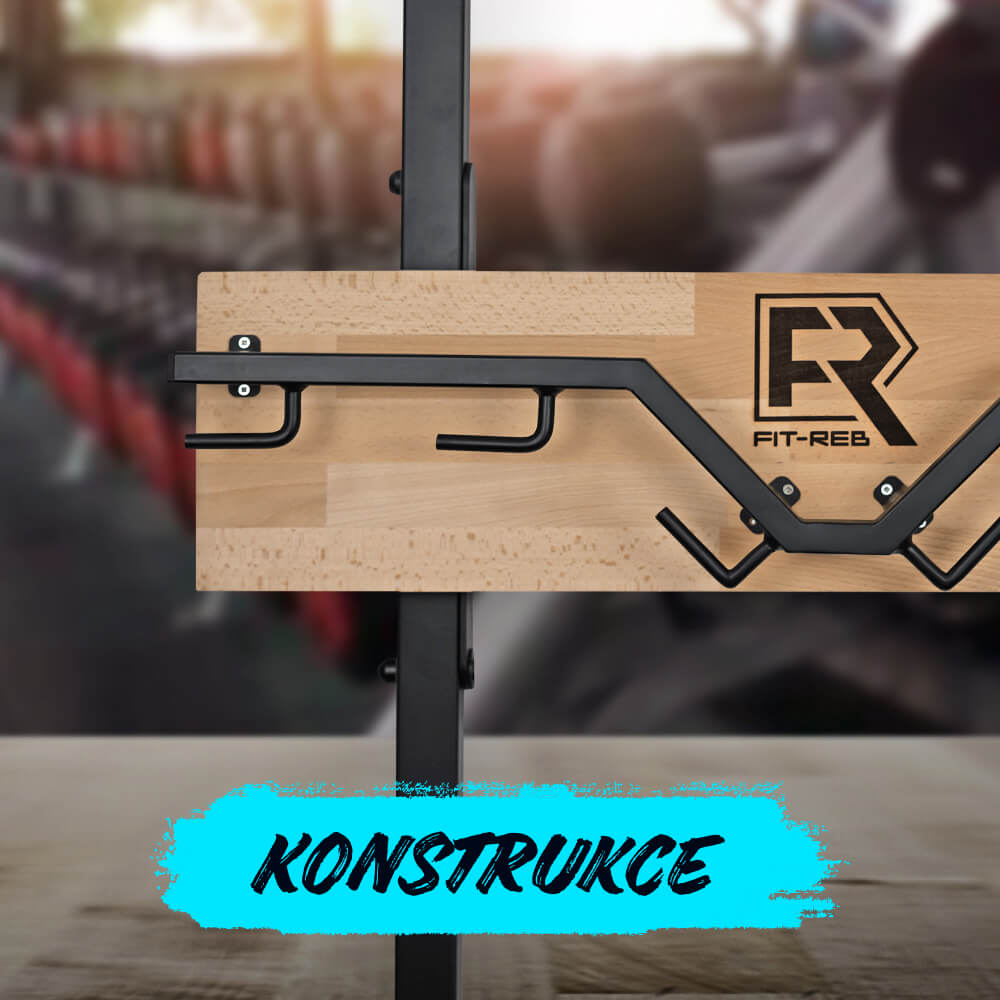
The FIT-REB frame is an exercise tool that allows you to train with resistance bands. With FIT-REB you can strengthen all muscles, improve flexibility, balance, and fitness. You can also adjust the difficulty of the exercise depending on how much you stretch or shorten the band. FIT-REB is suitable for anyone who wants to exercise at home, whether you are a beginner or an advanced athlete.
Everyone who exercises has a goal or an idea of what they want to achieve. Some training plans are designed to build muscle strength, others to improve the function of the cardiovascular system, meaning the heart and blood vessels. Most classic plans for the general population are designed for weight loss or muscle gain. For clarity, I will divide the integration of FIT-REB into aerobic and anaerobic training processes and then describe additional, more advanced mechanisms for using FIT-REB, for example to improve plyometrics, jump height, or balance.
FIT-REB and the aerobic type of training plan
You can think of aerobic activity as an activity in which we typically have a higher heart rate and which is performed continuously for a longer period of time, without pauses. Typical examples include running, cycling, or long-distance swimming. The opposite of aerobic activity is anaerobic activity. Aerobic means “with oxygen.” Glucose (sugar) is burned in cells, and it can be broken down either with or without oxygen. In aerobic activities, it is broken down with oxygen because the activity is not as acutely demanding, and the inhaled oxygen can reach the cells sufficiently for their energy needs.
The FIT-REB frame can be used here in several ways. One is to increase the body’s ability to withstand longer and more demanding efforts, as is the case with HIIT cardio. Another option is to include strength training on the FIT-REB frame to prevent injuries during aerobic activities or to improve the efficiency of aerobic performance. If, for example, I am a long-distance or recreational runner, including HIIT cardio with the FIT-REB frame will more closely resemble running itself. Conversely, if I start strength training with FIT-REB, then such training would be more compensatory and consist of exercises that move away from running.
I will start with strength training, because I think most people who engage in aerobic sports can benefit more from it. There used to be a widespread but mistaken belief that runners should not strength train much because it might make them heavier and subsequently slower, leading to a decline in performance. However, we now have studies that show that adding strength training to runners’ training plans can be very beneficial and ultimately increases their performance. This effect is likely due to the fact that runners who begin strength training gain better neuromuscular control over their muscles (they can control them better and more precisely), which improves running economy. (Running economy refers to how much oxygen a runner can consume at a given maximum speed. A runner with better running economy consumes significantly less oxygen at the same speed compared to a runner with worse RE.) Most runners do not include any compensatory gym training that would give them this benefit, which makes the FIT-REB frame a very good solution.
Another major advantage of strength training is its ability to reduce the risk of injury. We have very solid data showing that strength training is the most effective method in the world for reducing injury risk. Lauersen et al. (2018) indicate that simply including strength training for injury prevention—particularly for football players—reduces injury risk by 66%, which is remarkable. Thus, if you want a very good complement to your aerobic training, FIT-REB strength training can be the answer.
Another great principle for using FIT-REB is creating your own HIIT-type training on it. HIIT is characterized by short-duration, high-intensity activity performed in intervals. An example is a 100-meter sprint followed by a walking recovery back to the starting line. You can create a similar type of HIIT on the FIT-REB frame, such as running against band resistance, jumping vertically against band resistance, or many other possibilities. The only limit is your imagination, and our exercise library can provide inspiration. Today, interval training to music is popular, and the best-known format is “Tabata.” Tabata music is designed so that you can follow the melody to know when you are working and when you are resting. It is created in various ratios, the most common being 30 seconds of work and 30 seconds of rest. This type of training can also be built on the FIT-REB frame, and combining it with music can make the workout more enjoyable.
FIT-REB and the anaerobic type of training plan
Anaerobic glucose (sugar) metabolism means the absence of oxygen. This refers to exercise that is so energy-demanding that the cardiopulmonary system cannot supply enough oxygen to the cells, forcing them to operate in so-called oxygen debt. During oxygen debt, a larger amount of lactate is produced, which is a waste product of glucose metabolism without oxygen. Such exercise includes weightlifting or gym workouts. FIT-REB can again be used here in several ways.
The first is for so-called active recovery. We know that on a non-training day, simply flopping on the couch and resting is not as effective as doing some exercise, going for a walk, or at least performing some low-intensity activity. If you are a gym enthusiast, FIT-REB may enchant you with the possibility of creating a simple recovery-type workout that can complement your strength training at the gym. You can easily train either the whole body or just certain parts according to your preferences and thus speed up the recovery of your sore muscles. For most people, it will not be difficult to come up with exercises, but if you want inspiration, we have dozens of video tutorials ready for all muscle groups.
VIDEO tutorials
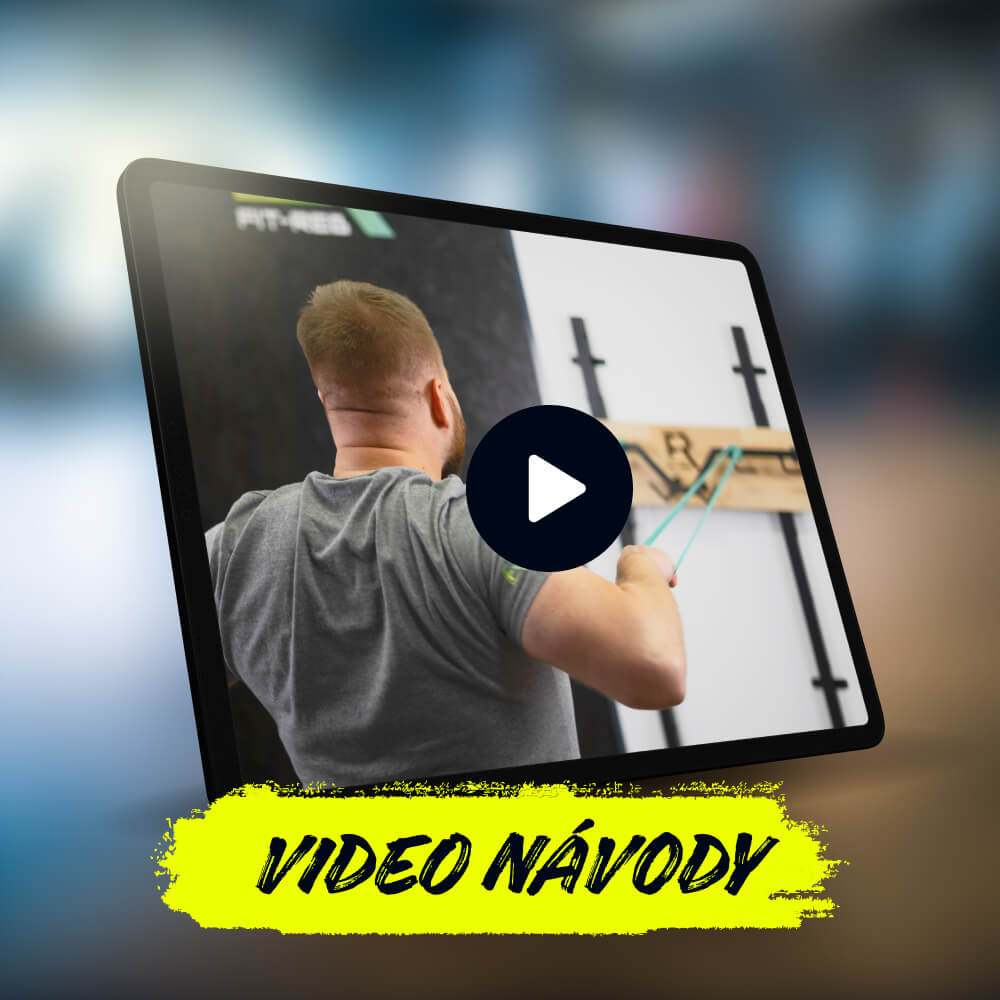
Are you missing full-body exercise inspiration with the FIT-REB frame? Not sure if you’re exercising correctly? We have prepared video tutorials for you, sorted by muscle groups and accompanied by expert commentary from a physiotherapist. And that’s not all. By purchasing the video tutorials, you gain access to a members’ section with premium content.
Another way to use FIT-REB can be as a substitute for workouts that you either cannot make in time or cannot attend at the gym for various reasons. Last but not least, there is of course the option to build supplementary workouts on the structure to complement your existing training sessions that include only basic exercises (such as the Korte training). Smaller muscle groups can then be trained separately outside of the Korte sessions at the gym. A supplementary workout can also be a personalized compensatory training tailored to your needs, which I can consult with you (you can find more about me here). And of course, a HIIT-type workout can also be much more appealing for many people who prefer strength training rather than traditional cardio like running or cycling.

Online consultation with a trainer and physiotherapist
Are you struggling with musculoskeletal pain or looking for an effective way to achieve better performance with the FIT-REB structure?Traditional approaches don’t work for you, or nothing has helped you in the long term? Our coach and physiotherapist Honza is here for you!
FIT-REB and compensatory training, plyometrics, range of motion and more
Compensatory training can be anything that complements your main training plan and improves a variable you need for it. It may be training to improve your range of motion because you are, for example, a volleyball player who needs more external rotation to spike harder at the net than others. Or it may be training to improve your jump because you already have good external rotation but cannot get high enough above the net, so you need to improve dynamic strength and turn your legs into powerful springs that launch you upward. FIT-REB can be used for all of this, and it is up to you and your needs what exactly you want to train.
It is generally good to introduce new elements in the off-season, because adding new components to your training program right before a competition could cause changes that might negatively affect your performance. This is mainly because the body is most susceptible to overload right before a competition due to heavy training, and therefore it is not advisable to make major changes at that time.
Last but not least, it is good to use FIT-REB to strengthen the core muscles, especially through thoracic rotations relative to the pelvis, exercises for the abdominal and back muscle groups, and exercises in which we try to maintain a stable torso while moving the upper and lower limbs.
Conclusion
In conclusion, FIT-REB is a home exercise tool that offers flexibility in strengthening muscles, improving flexibility, balance, and fitness for athletes of various levels. With the ability to adjust exercise difficulty using resistance bands, FIT-REB enables effective integration of both aerobic and anaerobic training into your fitness plan. Whether it is performance enhancement, injury prevention, HIIT training, or specific compensatory exercises and plyometrics, FIT-REB is a versatile tool that supports the development of physical abilities and health on many levels. All of this makes FIT-REB an ideal partner for anyone looking for an effective and adaptable way to exercise in the comfort of their home.
Author: Ing. Honza Fišer
References:
Lauersen JB, Andersen TE, Andersen LB. Strength training as superior, dose-dependent and safe prevention of acute and overuse sports injuries: a systematic review, qualitative analysis and meta-analysis. Br J Sports Med. 2018 Dec;52(24):1557-1563. doi: 10.1136/bjsports-2018-099078. Epub 2018 Aug 21. PMID: 30131332.


